


Research: Evidence-based Program

Dr Carole Haeusler and Dr Jenny Donovan
University of Southern Queensland

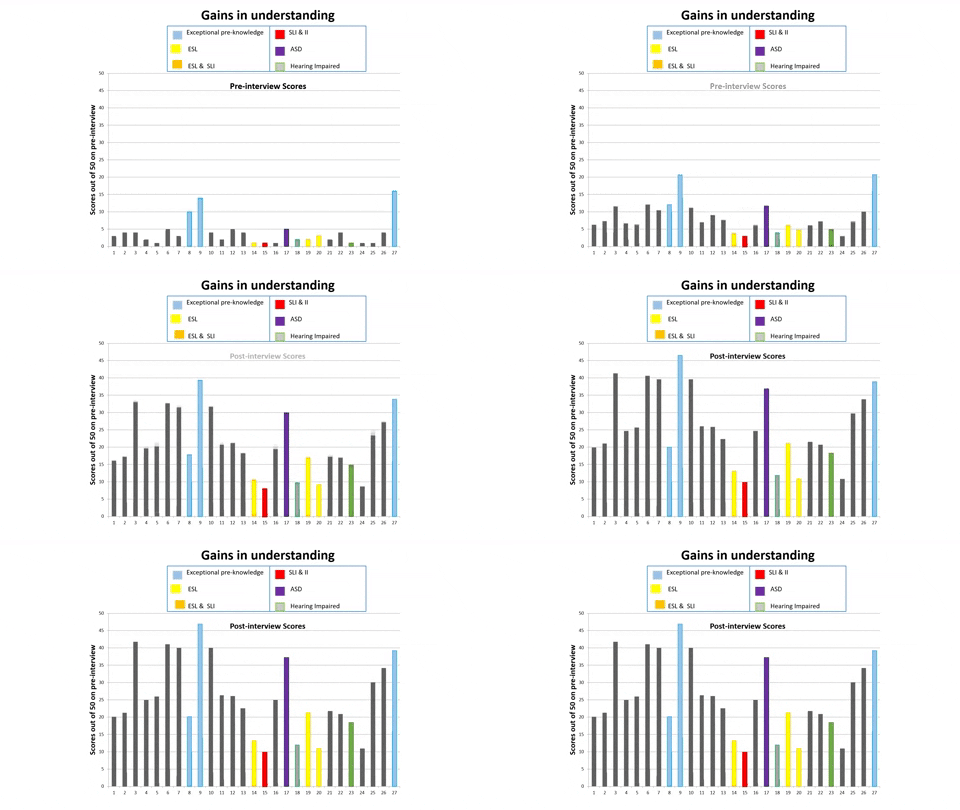
Atomic School has been fortunate to collaborate with Dr Jennifer Donovan and Dr Carole Haeusler from the University of Southern Queensland, who designed research and collected data from Year 3 and Year 4 Brisbane primary schools during an intervention that introduced Atomic Theory. In particular, they were interested in finding out whether students could understand Atomic Structure- how atoms are composed of protons, electrons and neutrons- and whether they could meaningfully apply their understanding to the macroscopic world.
Jenny and Carole's findings were:
“Firstly, primary school children aged 8 and 9 years can understand Atomic Theory at a surprisingly high level. In about 10 hours of Atomic Theory instruction, they gain understandings more robust than those reported in the literature for 14-year-old children (when this is taught in the curriculum) and several boasted they helped their Year 9 siblings with their chemistry homework!


Secondly, they love it. Particularly the Periodic Table of the Elements, they are passionate about it and one even said ‘It’s the alphabet of the Universe’. Wow, that amazed us.

Thirdly, in every school, we found at least one little bright spark who already knew a LOT about Atomic Theory that they had found out all by themselves. The depth and breadth of this knowledge also amazed us and their questions put us on the spot to answer them. Teachers, we need to encourage these minds and all the others too. Even children with learning difficulties enjoyed the program and learned a lot."

Research Papers

Haeusler, C., Donovan, J., Venville, G. (2020). Children Versus Curriculum: Who Wins?. In: Donovan, J., Trimmer, K., Flegg, N. (eds) Curriculum, Schooling and Applied Research. Palgrave Studies in Education Research Methods. Palgrave Macmillan, Cham. https://doi.org/10.1007/978-3-030-48822-2_7
Haeusler, C. & Donovan, J. (2017). Challenging the science curriculum paradigm: Teaching primary children atomic-molecular theory. Research in Science Education. doi 10.1007/s11165-017-9679-2 (winner of publication award, 2018)
Donovan, J., & Haeusler, C. (2015). Developing scientific literacy: Introducing primary aged children to atomic-molecular theory. In E. de Silva (Ed.), Cases on research-based teaching methods in science education. (pp. 30-63). Hershey, PA: IGI Global.
Haeusler, C. & Donovan, J. (2015). AERA Conference 2015 at Chicago USA.New Ways of Learning Atomic Theory for 9 Year Olds: Educational Justice for Elementary Children
Donovan, J., Haeusler, C., & Venville, G. (2015) Making meaning with models. International Journal of Multidisciplinary Research, 2(2), available at http://www.virginiaresearchinstitute.org/international-journal-of-multidisciplinary-research-journal-papers/
Further research is underway and the data and analysis are currently undergoing publication.
spacer.
Op-Ed paper
Haeusler, C., Donovan, J., & Stuart, I. (2013). The Conversation: Searching For Scientific Mozarts.